We use cookies to make your experience better. To comply with the new e-Privacy directive, we need to ask for your consent to set the cookies. Learn more

The Uncrowned King of Mont Blanc
The life of T. Graham Brown, physiologist and mountaineer
£14.95
In Stock
Usually dispatched within 24 hrs. Free delivery to UK for orders £25 and over
The Uncrowned King of Mont Blanc by Peter Foster is the story of Thomas Graham Brown: scientist, mountaineer and psychological paradox, most famous for his groundbreaking routes on the Brenva Face of Mont Blanc and his turbulent relationship with Frank Smythe.
| Cordee Code: | CPB169 |
|---|---|
| Page Size: | 156 x 234 mm |
| No of Pages: | 256 |
| Publisher: | Baton Wicks Publications |
| ISBN13: | 9781898573821 |
| Author: | Peter Foster |
| Published Date: | July 2019 |
| Edition: | 1st, July 2019 |
| Binding: | Paperback (flapped) |
| Illustrations: | 1x16pp colour plate |
| Weight: | 402g |
| Geoarea: | Alps Western (france, Switzerland, And Italy) |
| Product Type: | Book |
| Countries: | France |
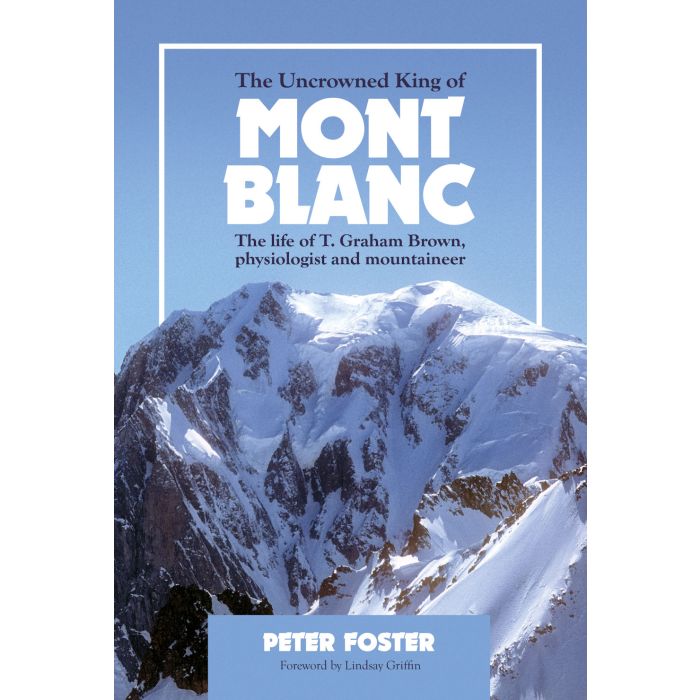
The Uncrowned King of Mont Blanc by Peter Foster is the biography of scientist and mountaineer Thomas Graham Brown, whose encyclopaedic knowledge of the mountain earned him the soubriquet, and whose achievements in the Alps and Greater Ranges place him at the forefront of British mountaineering between the two world wars.
Born in Edinburgh in 1882, Graham Brown first pursued a career in the sciences as a physiologist - his exacting father demanding the highest standards - and the results of his research, largely unrecognised at the time, now underpin current understanding of the nervous control of movement in animals and man. His mountaineering career began in earnest after the First World War. From rock climbing in the Lake District he progressed to guided climbs in the Alps, where in 1927 he was fatefully introduced to Frank Smythe with whom he made the groundbreaking first ascents of the Sentinelle Rouge and the Route Major on the Brenva Face of Mont Blanc.
This resulted in an obsession with the mountain and a feud between the pair that smouldered and flared for twenty years. Ambitious, determined and uncompromising in his views, he never left others feeling neutral: Geoffrey Winthrop Young thought him "a vicious lunatic", yet Charles Houston felt closer to Graham Brown 'than almost anyone else I know'. Graham Brown's life was one of turbulence in his career, relationships and in the mountains, whether on expeditions to Mount Foraker, Nanda Devi and Masherbrum, or most frequently, the Alps. Peter Foster has drawn upon diaries, letters and extensive archival research that illuminate the highs and lows of Graham Brown's scientific and climbing careers, and explores the imbalance between the significance of his achievements and the lack of recognition he received. But, above all, The Uncrowned King of Mont Blanc allows one to hear Graham Brown's voice: querulous, opinionated and, to the discomfort of his many adversaries, almost always right.
Born in Edinburgh in 1882, Graham Brown first pursued a career in the sciences as a physiologist - his exacting father demanding the highest standards - and the results of his research, largely unrecognised at the time, now underpin current understanding of the nervous control of movement in animals and man. His mountaineering career began in earnest after the First World War. From rock climbing in the Lake District he progressed to guided climbs in the Alps, where in 1927 he was fatefully introduced to Frank Smythe with whom he made the groundbreaking first ascents of the Sentinelle Rouge and the Route Major on the Brenva Face of Mont Blanc.
This resulted in an obsession with the mountain and a feud between the pair that smouldered and flared for twenty years. Ambitious, determined and uncompromising in his views, he never left others feeling neutral: Geoffrey Winthrop Young thought him "a vicious lunatic", yet Charles Houston felt closer to Graham Brown 'than almost anyone else I know'. Graham Brown's life was one of turbulence in his career, relationships and in the mountains, whether on expeditions to Mount Foraker, Nanda Devi and Masherbrum, or most frequently, the Alps. Peter Foster has drawn upon diaries, letters and extensive archival research that illuminate the highs and lows of Graham Brown's scientific and climbing careers, and explores the imbalance between the significance of his achievements and the lack of recognition he received. But, above all, The Uncrowned King of Mont Blanc allows one to hear Graham Brown's voice: querulous, opinionated and, to the discomfort of his many adversaries, almost always right.